Showing posts with label Bushcraft Skills Training Ireland. Show all posts

29 April 2021

Pigeon & Potato Stew

A freshly knocked down wood pigeon, converted into pigeon and potato stew. Potatoes from the garden. Washed down with some homemade blueberry gin. Gin aged about a year now, with coffee beans and oak bark.


6 November 2019

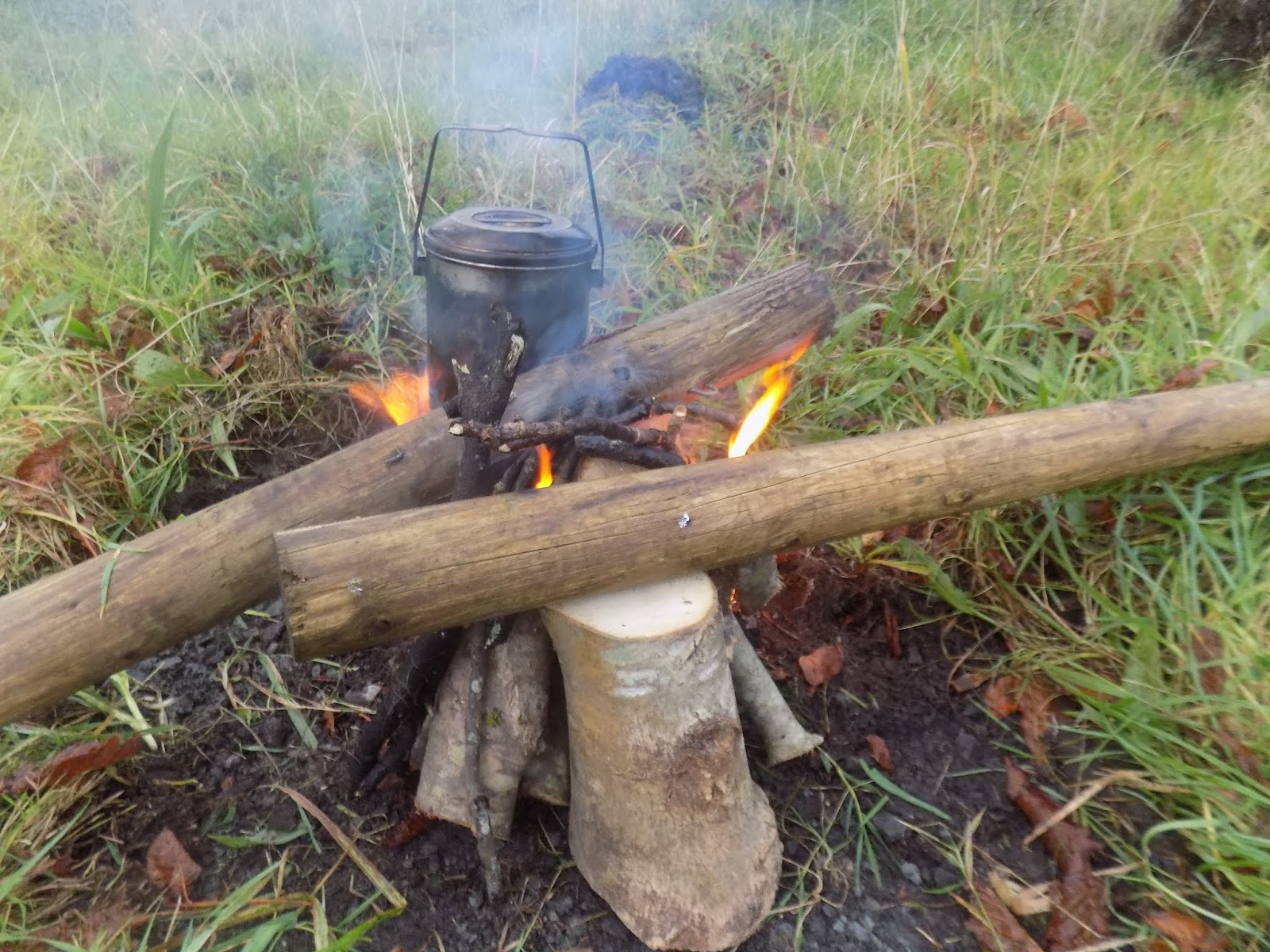
Simple Wilderness/Bushcraft Fire Setup

Setting A Campfire?

Here's A Nice Way To Go About It:


1. Big wet log or stump at back of fire (downwind side of fire). This contains the fire, prevents spread, reflects back a little heat and may well give you some red embers in morning. Depending on the shape of your back log - you may be able to sit a pot to simmer, as in first photo.

2. Smaller log at front of fire, again to contain fire, and cut down on fuel wastage.

3. Pyramid lay or teepee lay to your sticks to get fire going and initially roaring up.

4. Two to four long logs in fire, placed in from sides. This is called a star lay. As the fire fully catches and your star logs burn nicely, you can simply push them in to keep fire going, or increase heat. Or pull the star logs apart to slow down fire. See second photo especially for this.

30 October 2019

Broken Finger & Useful Mittens

Had a student with a broken finger on a recent bushcraft course. Cleaned it with plenty of clean water, then couple of plasters over the wound, and some surgical tape to splint broken finger to a good finger. Thankfully he wasn't in much pain - fair play to you Gavin!

Obviously spare/emergency gloves and spare/emergency hat in your backpack should be pretty standard - hopefully! But you can see here the bonus of using mittens instead of gloves. Imagine trying to fit a broken/splinted finger into a pair of regular gloves. These were €10 lidl mittens. Mittens are a super way to keep an injured hand warm and protected once first aid has been done.

People often say to me that mittens are clumsy, but I've found with practice most things still possible, including tying laces, tying knots and sending a text message!

2 July 2019

Good & Simple Bushcraft/Camping Food

'What's good food or simple food to bring bushcrafting or camping' gets asked on our bushcraft courses. To that I would say:

1. Tinned Soup
2. Tinned Baked Beans
3. Pasta & Tomato Sauce
4. Sausages
5. Fish
6. A Lump Of Meat
7. Bread & Cheese & Salami
8. Nuts & Dried Fruit
9. Regular Fruit

You are looking for nutritious/high energy/good quality food. Anything with salt, such as peanuts, is good for your hydration (drink plenty water also). Anything with fluid, such soup/pasta sauce, is also good for your hydration. Food in tins can often be heated directly in the tin. Avoid quick-fix stuff. Pre-cooked packet meals can be fine (like wayfarer meals), but ultimately much better to be cooking basically and properly yourself. Leave the packet meals at home!

The physiological benefit of a hot cooked and hydrating meal at least twice a day (breakfast and dinner) is huge.

28 June 2019

Bushcraft Skills 1 Course Available To Book For July

Due to request a last minute Bushcraft Skills 1 Course has been scheduled for 10th & 11th Jul, in Glengarriff/West Cork.

More details here: www.outdoorsireland.com/bushcraftsurvival.php

Get in touch please if you are interested in booking:
info@outdoorsireland.com
00353 86 860 45 63


15 June 2019

Bushcraft Skills 1 Syllabus

Bushcraft Skills 1 Syllabus:


Bushcraft V Survival
Order Of Priority
Rule Of Three

Efficient Movement
Efficient Gathering
Camp Consideration
Environment Consideration

Base Camp Shelter
Debris Shelter

Improvised Shelter
Survival Sleeping

Fire Building
Fire Management
Fire Cooking
Fire Utensil
Fire Tripod
Pot Hook
Pot Hanger

Water Gathering

Water Sterilisation

Knife Skills
Cordage Skills

Wood Ash
Wood Charcoal
Wild Foraging


Click Here To See See Course Dates
Click Here To Book A Course

6 April 2018

Simple Butchering & Cooking Of Venison

Young stag, most likely killed by a car. 2/3 days dead. Body in good
condition, outside and inside. Cold air temp keeping meat well preserved.
Took two hind legs, with the utmost respect for the animal. Then took the
body off the road to lie discreetly in the heather, ready to feed fox and bird.
Skinned.
Hung for five days in cool place.
With a little care while skinning (sharp blade and small'ish knife) the skin
will come off neatly.
Hot and settled fire, with red hot ember base. This is two hours after lighting.
Freshly cut green withies, in this case sally willow. One of the few times it is
alright to cut a living bough. Green sappy wood will not burn easy, which
is what you want for your spits.
Using one spit or two spits will depend on your meat size and shape. In this
case two spits were needed to spread the meat out evenly to ensure even
heat and cooking.
You will see two spits here and two forks. Spits are de-barked and sharpened
to slide easily through meat. Make sure your timber is not toxic, for example
not yew wood.
Take your time to really securely set up forks and spits, possibly using
heavy rocks. After all your work butchering, skinning and fire lighting
you do not want a flimsy cooking arrangement dumping your meat into
the mud or the fire.
Five hours cooking, cooked hot and well all the way through. Test and taste
the meat as you go. What you want to avoid is burnt on outside and
under cooked on inside. Hold your hand to heat at a point where after 5
seconds the heat is too much for you. This distance from fire is ideal for
cooking.
Flip the meat over on the spits from time to time, so the top side of joint gets
equal cooking to bottom side. Play around with your spits, forks and
rocks for this. The righthand spit here shows another method for getting
your spit height just right.
Ready to go. Good to mention taking meat from a dead animal, and even
more so when taking an animal's life, should be done with the utmost respect
to the animal. Even catching and killing a fish should be done with a little
sadness and a lot of respect - it is giving up it's life to feed you.
Using strong green sap-filled withies prevents them burning. You can see here
just a little scorching after five hours of use.

2 March 2017

Two Videos From Our Weekend In The Woods!

Setting up a smoking camp fire in prep for our Forest Skills 1 students to take a compass sighting on it from a 1km away vantage point; then zone in on it. Part of what we call 'escape navigation'.

Here students on last weekend's course are blindfolded and use their sense of smell and sense of hearing to zone in on a camp fire. The blindfolds replicate zero visibility, which is actually pretty rare - even at night. You may notice some of the students are in what we call 'defensive position' for moving through vegetation in zero visibility. One hand protecting the stomach/groin area and one hand protecting the face. The face hand continually waves back and forth to cover the entire face/neck area.

22 August 2016

Nearly Back To Bushcraft Time!

We are nearly back into our bushcraft season and cannot wait to get stuck back into making fire, building shelter and foraging!

Our next Bushcraft Skills 1 Course is 3rd & 4th Sep, including an overnight.

Click Here For More Details


Click Here To See Our Bushcraft Syllabus

26 April 2016

Boiling Water - Always

Found this dead sheep filtering down a fast flowing stream and into a lake last week.

In a survival or bushcraft situation you want to boil your drinking water, no matter how fast flowing or how pristine you think your water source. 1 min 'rolling boil' normally and a 3 min boil for altitudes of 2000 meters plus.

Because of the two different boil times and the fact a pan can slip off the boil momentarily, I say always go for a solid 3 min boil, wherever you are - to keep it simple.

Nathan-Outdoors Ireland